There is a particular kind of Canadian arithmetic that goes like this. Four months of winter. Heating bills, a driveway, darkness at half past four, and the growing suspicion that you are spending a third of every year simply enduring.
We ran that arithmetic years ago and started coming here. Then we rented a house for a full season to see what living here was actually like. Then we bought, and eventually built.
So this isn’t a guide written from a listing. It’s written from the winters.
Why a long stay is a different product from a holiday
A week here is a lovely holiday. A month or a season is something else entirely, and the difference is worth understanding before you book, because it changes what you should be looking for.
On a week’s holiday, nothing has to work properly. You tolerate a bad kitchen. You eat out every night. You don’t care where the water comes from or whether the internet holds a video call, because you brought nothing that needs it.
On a long stay, all of that becomes your actual life. You cook. You do laundry. You take calls. You need a chair you can sit in for three hours and a room you can close a door on. You need somewhere to put four months of belongings.
The single best predictor of whether a long stay goes well is whether the place was built for living rather than for photographs.
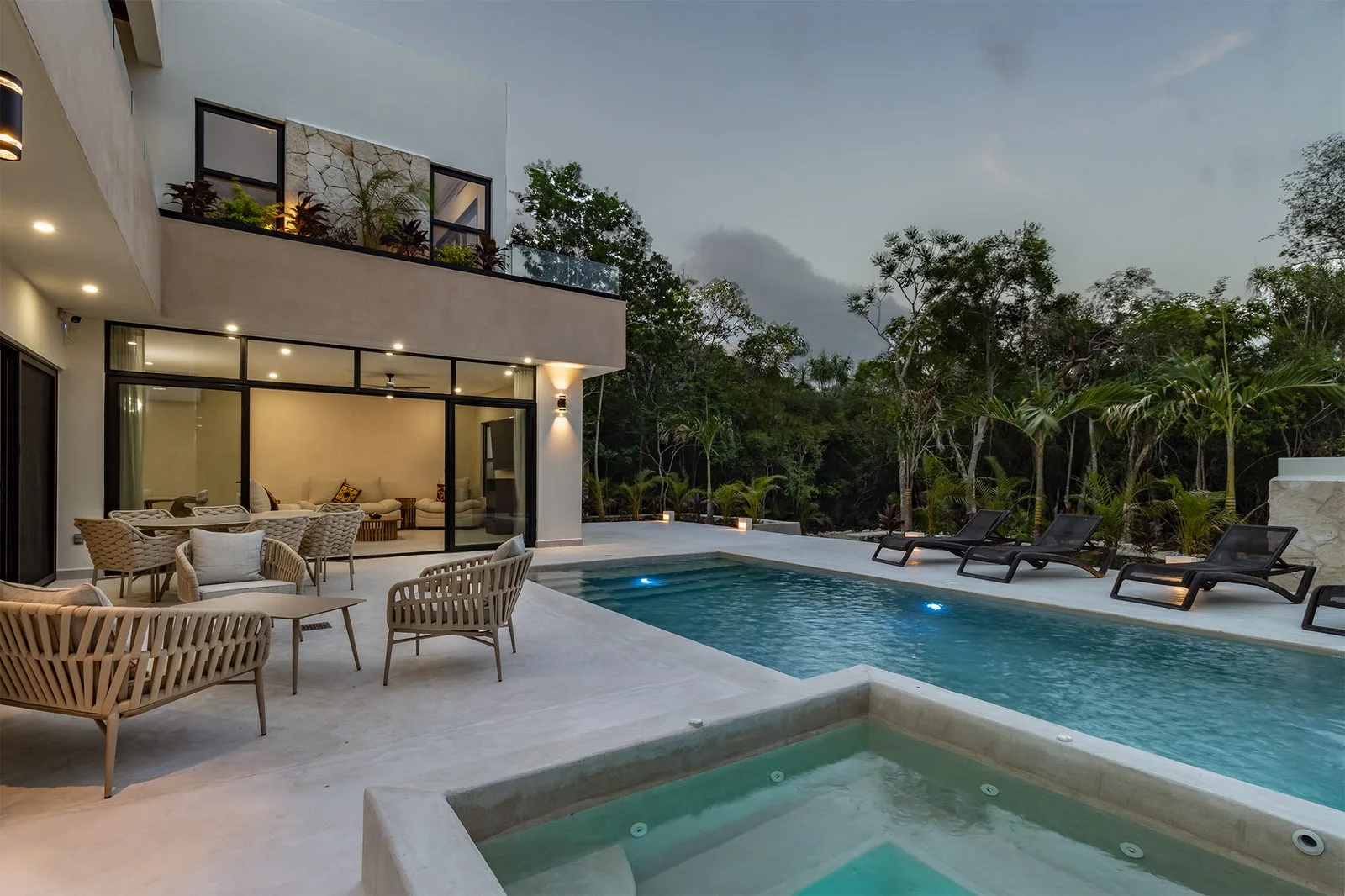
That is the honest reason we built the way we did — a real kitchen, four bedrooms of equal standing rather than one good room and three afterthoughts, laundry, and solar with Starlink so the power bill and the video call both behave.
The season, month by month
Broad strokes, and check current forecasts rather than trusting anybody’s averages, including mine.
December through April is the reason snowbirds come. This is the dry, cooler, less humid stretch — warm days, comfortable evenings, and the lowest chance of the sky opening on you. It is also, unsurprisingly, the busiest and most sought-after window on the whole coast. If you want a specific house for a specific stretch of that season, you are competing with everyone else who ran the same arithmetic you did.
May and into summer the heat and humidity climb noticeably. Beautiful still, but a different climate — and the point at which air conditioning stops being optional.
June through October is the rainy season, and it overlaps hurricane season, which formally runs from June into late November with the most active stretch late in the summer. Rain here is usually dramatic and brief rather than grey and all-day, but the roads take it hard, and storm risk is a real thing to plan around rather than dismiss.
November is the shoulder that people who know this coast quietly love. The heat has broken, the rain is easing, and the season hasn’t filled up yet.
The sargassum question — and why it barely touches you
If you’ve read anything about this coast you’ve read about sargassum: the brown seaweed that arrives in mats, some years mild, some years genuinely bad.
Here is the part that rarely makes it into the scary articles. Sargassum is mostly a spring-and-summer phenomenon. The heavy months are, almost exactly, the months a snowbird is not here.
We’re seasonal — we come to escape the Canadian winter — and in practice sargassum has barely touched our lives. If you were planning to live here year-round, or if you were buying a property whose income depended on summer bookings, it would be a first-order question. For a December-to-April stay, it mostly isn’t.
It also doesn’t hit the coast evenly. East-facing open beaches catch the worst of it; protected bays fare better. So if it matters to you, ask about the specific beach rather than “the area” — those are different questions with different answers.
Working from here
More long-stay guests are working now than when we started coming, and the honest requirement is simple: you need internet that doesn’t embarrass you on a call, and you need somewhere to sit that isn’t a dining chair.
We run Starlink at the house, which was a deliberate choice rather than a spec-sheet flourish. Coastal Mexican internet has historically been the thing that ruins remote work here, and satellite sidesteps most of what makes it unreliable.
The other half of working remotely is time zones, and this coast is kind about it — you are in a North American time zone, so a Toronto or Vancouver meeting doesn’t require a 5 a.m. alarm.
Groceries, cars, and the enclave question
Here is where I have to be straight with you, because it’s the thing most likely to make Akumal the wrong choice.
The residential communities here are enclaves, not towns. You are driving for groceries. You are driving to restaurants. There is no walk-to-dinner strip at the end of the street. If walking to a restaurant is central to your idea of a long stay, you want Playa del Carmen or Tulum, and I’d rather tell you that than take your booking.
What I can tell you is that the driving is easy and the alternatives are real. When we rented for our season, we learned that between cabs and colectivos — the shared vans that run the highway constantly — getting around without our own car was genuinely straightforward, and cheap. That surprised us, and it changed how we thought about vehicles entirely.
Groceries: there are proper supermarkets within a reasonable drive, plus the smaller local shops, and delivery for some things. You will not find everything you get at home, and you will find things you now can’t live without. That trade is most of the fun.
One road-safety note we treat as a rule rather than a preference: don’t drive the highway at night. Not because of anything dramatic — because of unlit stretches, speed bumps that appear out of nowhere, cyclists on the shoulder, and vehicles running without taillights. Daylight driving here is easy. Night driving is where the risk curve bends. Cabs are cheap and there’s no prize for driving yourself home at midnight.
Why the whole winter, and not a week
The reason we stopped taking holidays here and started living here for the season is that the good part only arrives after the holiday wears off.
In the first week you are a tourist. Somewhere in the second or third, the place stops being scenery. You have a fruit stand. You know which pharmacy is better. You’ve had a proper conversation with a neighbour. The mornings develop a rhythm, and the rhythm — not the beach — is the thing you end up missing in July.
That is also, incidentally, why we tell anyone thinking about buying here to rent a season before they buy anything. A week tells you that you love it, because you love everywhere on vacation. A season tells you the truth. Ours told us that the busy marina town we’d rented in wasn’t ours, and that the quiet enclave down the road was — which is the single most useful thing we learned in eighteen years on this coast.
Practical notes for a long booking
The house sleeps eight across four king bedrooms and four and a half bathrooms, which for a couple on a long stay means one bedroom to sleep in, one to work in, and two for the visitors who will absolutely turn up once they hear where you are. In our own place, winter is fully booked with visiting friends and family, and that’s exactly why we built four bedrooms rather than three.
Extended stays are welcome and are genuinely the use this house is best at. If you’re looking at a month or a season rather than a week, message me through the Airbnb listing with your dates and let’s talk about it properly — long bookings have moving parts that a standard reservation flow doesn’t handle well.
And book earlier than feels necessary. December-to-April on this coast fills up in late summer, which is probably why you’re reading this now.
Winter fills up in late summer. Check your dates.
Four bedrooms, a private pool, solar and Starlink, and a resort inside the same gates for the afternoons. Availability and booking run through Airbnb — message me there for anything longer than a couple of weeks.
Check availability on Airbnb